The library will hold its next Book Club for Writers discussion on Thursday, October 24. The discussion will feature short stories by three contemporary, prize-winning writers who are all interested in the fantastic: Michael Chabon, Jonathan Lethem, and Steven Millhauser.

Copies of Chabon’s “In the Black Mill,” Lethem’s “Super Goat Man,” and Millhauser’s “Cat ’n’ Mouse” will be available from the library in advance. The discussion will begin at 7:00 PM and will be free and open to the public.
Winner of the Pulitzer Prize for his novel
The Amazing Adventures of Kavalier & Clay and of the Hugo and Nebula awards for
The Yiddish Policemen’s Union, Michael Chabon is the author most recently of
Telegraph Avenue. Chabon is known for blending elements of genre and literary fiction in his writing. “In the Black Mill” is purported to be the work of August Van Zorn, a fictional persona that Chabon has fashioned. Van Zorn is said to be a writer of pulp horror stories in the tradition of Lovecraft and Poe.

Jonathan Lethem’s novel
Motherless Brooklyn won the National Book Critics Circle Award for Fiction and his novel
The Fortress of Solitude was a bestseller. His most recent book,
Dissident Gardens, was just published last month. In 2005, he was awarded a MacArthur Fellowship, the so-called “genius grant.” Lethem is another writer known for blending literary and genre styles, an approach that characterizes “Super Goat Man,” a story first published in
The New Yorker.
Steven Millhauser won the Pulitzer Prize for his novel
Martin Dressler, but he is perhaps best-known as a writer of short stories. Millhauser’s stories are reminiscent of Poe and Borges; “his characteristic method,” says Jonathan Lethem, “mingles dreamlike and often morbid or perverse fantasies with meticulous realist observation.” Millhauser teaches at Skidmore College and his collections include
In the Penny Arcade,
The Barnum Museum, and
The Knife Thrower. Lethem says that “Cat ’n’ Mouse” appears in his own personal “Millhauser hall of fame.”

Book Club for Writers is a fiction discussion program that meets four times a year. Discussions are open to all, and focus particularly on questions of craft and technique that will interest writers and aspiring writers. Created by the New Hampshire Writers’ Project, Book Club for Writers is sponsored locally by a fiction writing group that meets weekly at the Haverhill Corner Library.
The next Book Club for Writers discussion will be held on Thursday, January 23, 2014 and will feature “Mister Squishy” by David Foster Wallace, and two stories by George Saunders, “In Persuasion Nation” and “The Semplica Girl Diaries.”


 These are just a few of the many wonderful children's books we have in the library. Come and check them out!!
 Published in 1958, The Once and Future King is White’s contemporary reinterpretation of the legends of King Arthur. This volume collected White’s three earlier Arthurian fantasies and added the concluding tale, so that the four sections of the book are: “The Sword in the Stone”; “The Queen of Air and Darkness”; “The Ill-Made Knight”; and “The Candle in the Wind.”
 Originally published in three volumes in 1954 and 1955, The Lord of the Rings became one of the most important and influential fantasy novels of the twentieth century. Indeed, its success was so great that the “high fantasy” mode that the book exemplified became the dominant, and almost only, commercially viable form of fantasy for many years. More than that, the book became an American cultural phenomenon in the mid-1960s and has become one of the best-selling titles in history.
 Copies of Chabon’s “In the Black Mill,” Lethem’s “Super Goat Man,” and Millhauser’s “Cat ’n’ Mouse” will be available from the library in advance. The discussion will begin at 7:00 PM and will be free and open to the public.
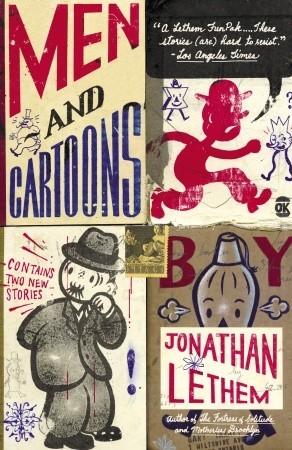 Jonathan Lethem’s novel Motherless Brooklyn won the National Book Critics Circle Award for Fiction and his novel The Fortress of Solitude was a bestseller. His most recent book, Dissident Gardens, was just published last month. In 2005, he was awarded a MacArthur Fellowship, the so-called “genius grant.” Lethem is another writer known for blending literary and genre styles, an approach that characterizes “Super Goat Man,” a story first published in The New Yorker.
 Book Club for Writers is a fiction discussion program that meets four times a year. Discussions are open to all, and focus particularly on questions of craft and technique that will interest writers and aspiring writers. Created by the New Hampshire Writers’ Project, Book Club for Writers is sponsored locally by a fiction writing group that meets weekly at the Haverhill Corner Library.